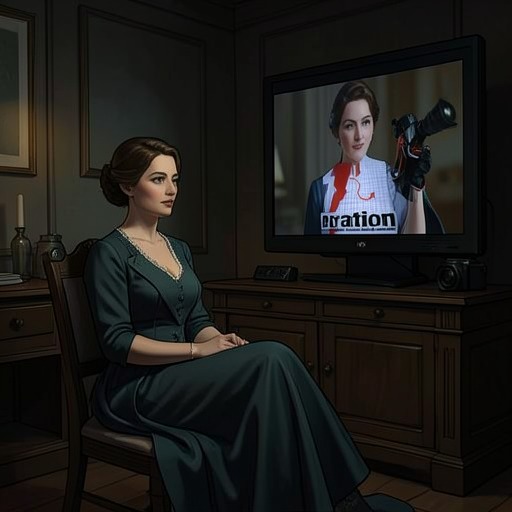
Redemption through the documentary
Luckiest Girl AliveRedemption through the documentary begins as TifAni FaNelli’s chance to reclaim her public identity, but it also exposes the conditions she places on being believed. She hopes a film will clear her name and let her tell her side of the story; at first, however, she imagines that truth arriving only after she has assembled an image of success and decided which parts of her history can be spoken. Later, microphones capture a consequential conversation she had not set out to make public. The documentary therefore becomes both a platform for self-narration and a record that can exceed the narrator’s control.
A Chance to Correct Her Name
The prospect of filming matters to TifAni because the distance between her present identity and her past remains vulnerable to public confusion. When Spencer mistakenly calls her TifAni instead of Ani, TifAni imagines that the documentary’s camera will make clear who she is and what she did. Her confidence in that possibility sits beside her sense of herself as a person who manufactures socially expected reactions. The camera promises clarity, but the person it will clarify is already conscious of performing.
The documentary offer comes from HBO, which contacts her about a project loosely titled Friends of the Five. TifAni sees an opportunity to redeem herself and tell her account, even as she recognizes that she was not actually a friend of the five. The distinction matters: the film’s title gives the project a public frame, while her hoped-for contribution would correct the place assigned to her within the story. She imagines the camera not merely recording her, but changing how others interpret her.
Redemption and the Performance of Success
TifAni’s preparation for the documentary is bound up with her idea of having made it. She has pushed for an engagement to Luke Harrison and treats the engagement as one more credential: alongside a desirable job, an impressive address, and a carefully managed body, a wealthy fiancé would make her rise seem secure. She pictures the emerald ring on her hand as she tells her story to the camera. The image joins testimony to status, as if public credibility could be strengthened by visible proof of private success.
The engagement is not simply a milestone she accepts passively. TifAni has pressed Luke to marry her, although he would have preferred to wait until the following year’s bonus. He eventually has Mammy’s emerald ring reset for her, and she agrees to take part in the film. She knows that relying on a ring to feel established conflicts with her ideal of independence, but she does not pretend to have escaped that need. Her documentary plan thus contains a contradiction: she wants the film to establish her worth while relying on conventional signs of worth to make its appearance feel safe.
That logic also shapes what she initially agrees to disclose. Luke does not want her to discuss that night, a phrase that allows the sexual assaults by Peyton Powell, Liam Ross, and especially Dean Barton to remain unnamed. TifAni considers speaking about them, but decides against it because she does not yet have the emerald ring. She tells Luke she will not discuss the night. The postponement shows redemption as conditional: she wants to claim her story, but first wants the protection and status she believes the ring will provide.
The Interview as a Controlled Performance
When filming begins, the production gives TifAni a defined role and a tightly planned setting. She is asked to state her name, age, and age on November 12, 2001, before telling her account. The studio is a black-walled room above a Starbucks in Media, Pennsylvania; a makeup artist checks her foundation, and the first recording is treated as a sound check. The production also plans location shots around the outskirts of the Bradley School, where TifAni will identify places connected to the turning points of her life.
Aaron asks her to speak continuously, from beginning to end, in one take. He describes emotional continuity as important and tells her to continue if she becomes tearful, while allowing that he may redirect her if she digresses. His instructions make the interview more than a simple invitation to speak: they establish a preferred shape for her testimony, including its sequence, pace, and emotional legibility. TifAni, for her part, anticipates that she might become physically ill rather than cry. Her composure is not evidence that the material has lost its force; it is part of the difficulty of presenting it in a form the production can use.
A Public Record Already in Dispute
The documentary’s promise sits within a community that has already judged TifAni. After the Bradley attack, there is not enough evidence to charge her with a crime, but public suspicion persists. Notes, yearbook writing, and her fingerprints on a gun are used to cast doubt on her; a school counselor’s assessment of her emotional response is also turned against her. Dean’s account that Arthur gave TifAni the gun and told her to kill him becomes especially damaging, despite TifAni’s assertion that Arthur never said this. A documentary offering her version would therefore enter an argument already shaped by reputation, grief, and unequal credibility.
The broader interpretation of the attack is disputed as well. Public accounts describe Arthur Finnerman and Ben Hunter as bullied, while police reports and the psychologists’ review of journals, records, and interviews point to a different account of motive and planning. The novel does not establish that TifAni’s documentary resolves these competing explanations. Instead, that surrounding dispute clarifies the stakes of her attempt: telling a personal truth takes place amid public narratives that simplify events and assign blame.
Recording, Disclosure, and the Limits of Control
The production’s recording devices eventually preserve material outside TifAni’s planned account. During a filmed confrontation, she presses Dean to take responsibility for his past conduct. Dean tells the crew to stop filming, and Aaron initially does not appear to understand the full history behind TifAni’s challenge. The film crew stops recording at the director’s instruction, but the conversation has already been captured because both TifAni and Dean are wearing microphones.
Aaron later tells TifAni that he has reviewed the footage. She had wanted Dean to name what happened as rape, partly because she believed the microphones might preserve words a camera could not otherwise document. Once Luke is no longer the person whose name she fears sullying, she asks whether the recording can support her story. Aaron acknowledges the material’s value to him as a director, but also responds as her friend and warns that making it public could provoke outrage. His response recognizes both the documentary’s evidentiary power and the cost of releasing the evidence.
The concept of redemption remains deliberately unsettled. TifAni once hopes that the film will clear her name, yet the available scenes do not establish what the finished documentary ultimately shows or how the public receives it. What changes is her willingness to consider speaking about the sexual assaults and to use a recording that captures Dean naming the harm. The film does not guarantee that others will believe her; it gives her a means to place her account into a public record, while exposing how far that act remains entangled with image, editing, and the risk of renewed judgment.